How to Choose the Right Pond Filter
A Simple Buyer’s Guide to Every Main Filter Type
If you feed fish daily, waste builds up daily. The right filter removes solids before they break down and gives beneficial bacteria enough space to convert ammonia into safer compounds.
Choose badly and you’ll be cleaning constantly. Choose well and your pond runs quietly in the background.
Below are the main pond filter types, how they work and where each fits.
1. Box Filters (All-in-One Units)
Best for: Small ornamental ponds with light fish loads
Setup: Pump-fed
How they work
Water is pumped through foam sponges and basic biological media. Many include a built-in UV-C to control green water.
Benefits
- Affordable entry point
- Easy to install
- Compact footprint
- Simple cleaning systems
Drawbacks
- Limited biological capacity
- Foam blocks clog quickly with heavy feeding
- Not suited to heavily stocked koi ponds
Bottom line: Fine for small decorative ponds. Not designed for serious koi keeping.
2. Pressure Filters
Best for: Small to medium ponds where space is limited
Setup: Pump-fed
How they work
A sealed vessel forces water through mechanical and biological media under pressure. Because they’re pressurised, they can sit below water level or be partially buried.
Benefits
- Tidy installation
- Flexible positioning
- Often include UV-C
- Back-flush cleaning systems
Drawbacks
- Pump works harder against pressure
- Media can compact over time
- Limited capacity compared to open systems
Bottom line: Good when space is tight, but not ideal for high fish loads.
3. Multi-Chamber Filters
Best for: Medium garden ponds
Setup: Pump-fed or gravity-fed
How they work
Water passes through separate bays – usually brushes or foam for mechanical filtration, then biological media for bacteria to colonise.
Benefits
- Clear separation of mechanical and biological stages
- Easy to upgrade media
- Simple design
- Good value for pond volume
Drawbacks
- Manual cleaning required
- Larger footprint
- Can clog if undersized
Bottom line: A solid mid-range option if you’re happy to maintain it regularly.
4. Sieve Filters (Mechanical Pre-Filters)
Best for: Removing solids before the main filter
Setup: Commonly gravity-fed
How they work
Water flows over a fine screen. Solid waste stays on the screen and drops into a waste tray.
Benefits
- Removes solids before they break down
- Reduces strain on biological filters
- Improves water clarity
Drawbacks
- No biological filtration
- Requires regular emptying
Bottom line: Excellent first stage for koi ponds, but must be paired with bio filtration.
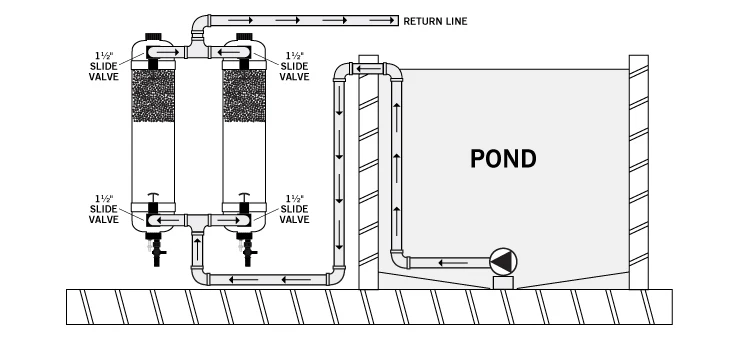
5. Bead Filters (Pressurised Biological Systems)
Best for: Koi ponds needing compact filtration
Setup: Pump-fed
How they work
A pressurised vessel filled with floating media provides biological filtration. A multiport valve allows backwashing to clean the media.
Benefits
- Strong biological performance in a small space
- Easy backwash operation
- Sealed and tidy
Drawbacks
- Needs good mechanical pre-filtration
- Can clog if fed heavy solids
- Backwashing uses pond water
Bottom line: Effective biological stage when combined with proper pre-filtration.
6. Drum Filters (Automatic Mechanical Filtration)
Best for: Medium to large koi ponds
Setup: Pump-fed or gravity-fed
How they work
Water passes through a fine stainless screen. As debris blocks the screen, sensors trigger an automatic rinse cycle. Waste is flushed to drain.
Benefits
- Automatic cleaning
- Removes waste immediately
- Handles high flow rates
- Reduces manual maintenance dramatically
Drawbacks
- Higher initial investment
- Requires electrical connection
- Needs waste outlet
Bottom line: The benchmark for serious koi keepers who want consistent clarity with minimal effort.
7. Combi Drum Filters (Drum + Bio Chamber)
Best for: Koi ponds needing complete filtration in one unit
Setup: Pump-fed or gravity-fed
How they work
A drum handles mechanical waste removal, followed by a biological chamber – often moving-bed media. Many include integrated UV-C.
Benefits
- Full filtration system in one unit
- Strong mechanical and biological performance
- Lower routine maintenance
- Professional-level setup
Drawbacks
- Larger footprint
- Higher budget
- Requires correct pipe sizing
Bottom line: Ideal for medium to large koi ponds where stability and ease matter.
8. Shower Filters (Trickle Biological Systems)
Best for: Boosting biological capacity
Setup: Installed after mechanical filtration
How they work
Water trickles over highly porous media in open trays. Air exposure increases oxygen levels and supports beneficial bacteria.
Benefits
- Excellent oxygenation
- Strong biological performance
- Helps stabilise water quality
Drawbacks
- Requires height
- Can cool water in winter
- Needs solid pre-filtration
Bottom line: A powerful biological upgrade, not a standalone filter.
9. Plant-Based Natural Filtration
Best for: Wildlife ponds and natural swimming ponds
How they work
Aquatic plants absorb nutrients while gravel beds provide surface area for bacteria.
Benefits
- Low energy use
- Natural appearance
- Wildlife-friendly
Drawbacks
- Water clarity fluctuates
- Not suitable for koi
- Slower response to heavy feeding
Bottom line: Great for natural systems, not for stocked koi ponds.
How to Choose the Right Filter
1. Start With Pond Volume
Undersizing is the most common mistake. Always match the filter to your true water volume, not just the pond’s dimensions on paper.
2. Consider Fish Load
More fish means:
- More solid waste
- More ammonia
- Greater oxygen demand
Heavy feeding demands strong mechanical filtration first.
3. Decide Pump-Fed or Gravity-Fed
Pump-fed systems
- Easier to retrofit
- Use smaller pipework
- Suitable for many garden ponds
Gravity-fed systems
- Use larger pipework
- Ideal for koi ponds
- Allow high flow rates efficiently
4. Think About Maintenance
Ask yourself:
- Do you want weekly hands-on cleaning?
- Or automatic self-cleaning?
The more fish you keep, the more valuable automation becomes.
Quick Comparison
| Filter Type | Maintenance Level | Best For | Koi Suitable |
|---|---|---|---|
| Box Filter | High | Small ponds | No |
| Pressure Filter | Medium | Small–medium ponds | Light stocking |
| Multi-Chamber | Medium | Medium ponds | Moderate stocking |
| Sieve | Low | Pre-filtration | Yes |
| Bead | Medium | Compact koi systems | Yes |
| Drum | Low | Koi ponds | Yes |
| Combi Drum | Very low | Serious koi systems | Yes |
| Shower | Low | Bio upgrade | Yes |
| Plant-Based | Low | Wildlife ponds | No |
The Simple Rule
Mechanical filtration first. Biological filtration second. UV-C for green water control. Good circulation throughout.
Get those four right and your pond becomes stable, clear and predictable.